book review · A Foray into the Worlds of Animals and Humans
A Foray into the Worlds of Animals and Humans
2026-08-04 · 3 min read
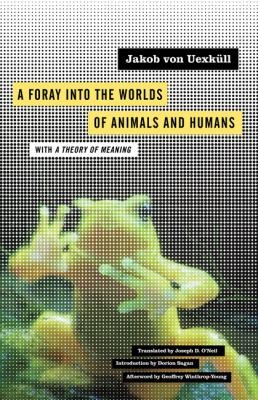
This is not a book I’d have picked up on my own, someone with a background in philosophy handed it to me and said just trust the process, and honestly that’s about the only reason I stuck with the first thirty pages. Von Uexkull is writing in 1934 about something he calls the umwelt, the idea that every animal doesn’t just perceive a smaller slice of the same world we do, it inhabits an entirely separate perceptual world built out of only the signals that matter to it. A tick doesn’t experience a forest. It experiences a narrow tunnel of butyric acid and warmth and nothing else.
Once that idea lands it’s hard to unsee, and I mean that as praise. I found myself thinking about it constantly with my own dog, wondering what her actual umwelt looks like versus what I project onto her. The book is genuinely one of the strangest things I’ve read, “quirky” is the word that kept coming to mind by the end, and I don’t mean that as a knock. It sits in this odd space between hard biology and something closer to phenomenology, and it’s not an accident that it directly influenced people like Heidegger and Merleau-Ponty, you can feel the DNA of later philosophy of mind sitting right there in the source text.
It’s short, which helps, because the prose from this era can be dense in a way that fights you. A few of the examples with ticks and sea urchins get revisited more than they probably needed to. But there’s nothing filler about the core argument, and the translation holds up better than I expected for something this old.
Not a casual read, not something I’d hand to someone who just wants a fun animal book. But if you’ve ever wondered what it’s actually like to be something else, this is closer to an answer than anything else I’ve read.